



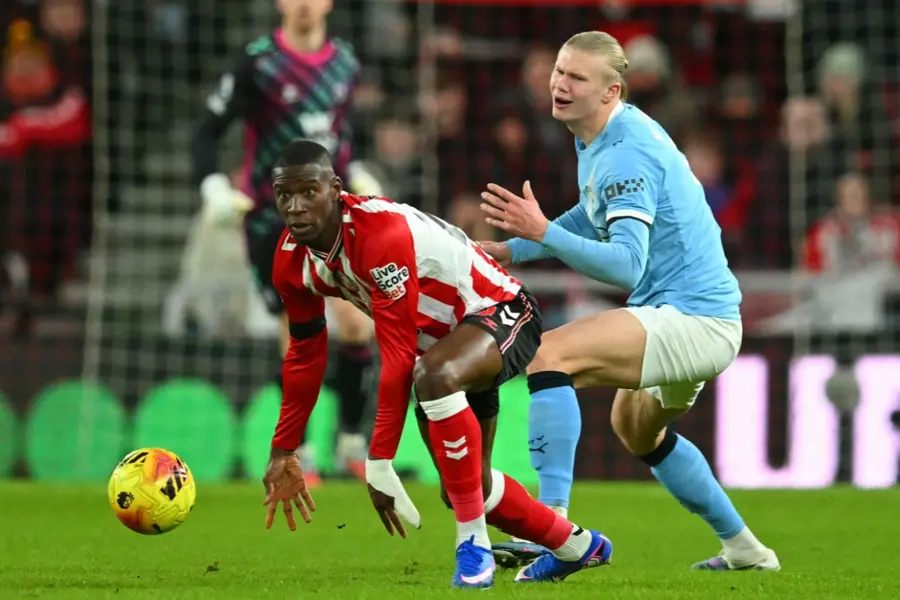
Teams that insisted on working the ball patiently around the edge of the box in the 2018/2019 Premier League gained control and shot quality, but they also exposed themselves to counter-attacks when possession broke down. The trade-off between carefully probing outside the area and leaving space behind became one of the defining tactical tensions of that season.
Why playing in front of the box naturally opens counter lanes
Circulating the ball just outside the penalty area usually means pushing multiple players high—full-backs, interiors, and often a holding midfielder stepping in—to compress the opponent’s block. That structure improves the chance of finding a gap, but it also means that when possession is lost, many of your “rest defence” players are in advanced positions with large spaces behind them. Modern tactical education describes this as the moment where offensive organisation turns into defensive vulnerability: the more players committed between the lines, the fewer left to control counters.
Analyses of pressing and defensive variables show that teams which defend with fewer players behind the ball concede more dangerous transitions when they lose it in advanced zones. One empirical study on defensive team variables found that factors like poor compactness and insufficient numbers behind the ball correlated with higher-quality chances conceded, particularly from fast attacks. Edge-of-box possession is precisely the scenario where those variables can go wrong if the attacking side is careless or badly structured.
2018/2019 possession-focused teams around the penalty area
In 2018/2019, several top and upper-mid-table clubs built their identity around sustained possession and multi-pass combinations in the final third. City, under Guardiola, used positional play to move the ball around the box, attempting to draw low blocks out of shape through short passes and third-man runs rather than direct crosses alone. Tactical pieces on how to break low 5‑4‑1 blocks describe exactly this pattern: frequent short passing between half-spaces and wide lanes just outside the area, with the single pivot and centre-backs holding extremely high starting positions.
Similarly, Chelsea under Sarri leaned heavily on short passing structures from Jorginho and the back line into the zones in front of the penalty area, a pattern reflected in Jorginho’s league-leading accurate pass numbers in that season’s data set. Arsenal and Spurs also had phases where they emphasised intricate combinations on the edge rather than constant crossing, relying on technical midfielders and forwards to fashion openings through tight exchanges.
These teams were not reckless; they usually maintained some form of rest defence. But the more they squeezed the pitch toward the box, the more the geometry of potential counters worked against them if the ball was lost cleanly.
Mechanisms that turn edge-of-box passing into counter threats
The link between front-of-box circulation and counter-attacks follows a fairly consistent mechanism:
How the pattern unfolds
- The attacking team moves multiple players into and around zone 14 (central just outside the box) and the half-spaces, aiming for short passes and quick combinations.
- Full-backs or wing-backs often push high to provide width, leaving only two centre-backs and possibly one holding midfielder covering large spaces behind.
- If the defending team wins the ball with a clean tackle, interception, or blocked pass that stays in play, they can immediately play forward or into wide channels, where there is space because the attacking full-backs are advanced.
- Fast forwards or wingers then attack the open field, creating transition chances that carry higher expected goals than the average settled attack because the defensive block is not set.
Research on counter-attacks shows that direct attacks and transitions are statistically more likely to result in goals than slow, multi-pass build-ups when they start with space ahead and a broken defensive shape. Edge-of-box passing, if not supported by a strong counter-press, effectively manufactures those starting conditions for the opponent.
When edge-of-box teams control counters well
Not all teams that passed patiently at the top of the box in 2018/2019 were equally vulnerable. The best sides invested heavily in “rest defence” and counter-pressing, using their own structure as a defensive tool. For example, positional play frameworks advocate keeping at least two, often three, players in staggered positions behind the ball—centre-backs spread to cover depth and a midfielder occupying the central lane—to slow or stop counter-attacks the moment possession is lost.
When those rest-defence units are in place and the team reacts immediately to loss, edge-of-box circulation can actually reduce counter danger. The ball is lost in a crowded area where multiple players are close enough to press the ball-carrier or foul smartly, and the opponent struggles to find a clean first forward pass. In these cases, the attacking team enjoys the benefits of controlled probing without paying the full counter‑attack cost.
Where UFABET fits into reading counter risk from playing style
If you want to use these patterns in a pre-match betting context, the analysis of edge-of-box play and counter vulnerability should come before any look at prices or markets. A structured routine would start by classifying teams from a season like 2018/2019 into profiles—possession-heavy with strong rest defence, possession-heavy with weaker counter control, and more direct or low‑block sides. From there, you’d look at matchups where a team that loves to combine in front of the box faces an opponent with clear transition weapons and speed. Only after that logic is clear does it make sense to choose markets, whether you eventually implement those ideas through a sports betting service such as ufabet เว็บตรง or elsewhere. Under this approach, the platform simply executes a plan built on tactical cause and effect.
How opponent style turns patient probing into a counter risk multiplier
Counter-attacks do not happen in a vacuum; they require a willing or capable opponent. Teams that sat in low blocks but kept quick forwards high—rather than dropping all eleven into their own box—were best placed to exploit the spaces left by edge-of-box possession. Tactical education materials on low blocks highlight exactly this trade-off: the defending side concedes territory in its own half in order to compress space around its box, but keeps one or two players higher to threaten on the break as soon as the ball is recovered.
In 2018/2019, that meant that when a possession-dominant side lost the ball near the box against a well-organised low block with pace up front, the transition threat was immediate. If, on the other hand, the opponent also committed many players deep and lacked speed, the same edge-of-box passing resulted in attacks dying without much counter danger. For pre-match reading, it is not enough to say “this team plays in front of the box”; you also have to ask, “does the other team have the tools and the intention to counter?”
Where a casino online context can weaken or support this analysis
Thinking clearly about edge-of-box patterns and counters requires slow reasoning; betting environments are designed for speed. If you’re working within a broader online gambling context, the risk is that you abandon your pre-match reading as soon as in-play swings create emotional pressure. The safest approach is to treat your 2018/2019-style tactical notes—who probes in front of the box, who counters well—as a separate reference that you consult before entering any market inside a casino online website. That way, even when live odds move, you are anchored to a prior view of which team is structurally more likely to be hit in transition, rather than reacting only to the last attack or highlight.
You can also log outcomes over time: matches where you expected high counter potential against a possession-heavy side and what actually happened. If those logs show that your edge-of-box/counter mapping consistently matches transition shot counts, you can justify giving that factor more weight. If not, it signals that you may be overrating style labels or underrating other variables like individual errors and set pieces.
Failure cases: when edge-of-box play does not lead to counters
Even for teams known for intricate play around the box, several conditions can break the expected link to counters. First, some sides adjust their risk level by keeping extra players back in big matches, especially away from home or late in the season, reducing the space they leave behind even when they still combine outside the area. Second, weather and pitch conditions can slow the ball and make quick transitions harder to execute, lowering the impact of each turnover.
Moreover, referee tendencies and card risk can change how opponents approach counters: if early yellow cards punish tactical fouls, the possession team may become more cautious in committing numbers forward; if officials are lenient, they can break up counters more aggressively without playing at a numerical disadvantage. Finally, a few early counters can force a coach to change shape mid-game, adding an extra pivot or pulling full-backs back, which decouples the rest of the match from the pre-match expectation based on usual 2018/2019 patterns.
Summary
In the 2018/2019 Premier League, teams that liked to circulate the ball in front of the penalty area traded better shot quality and control for increased counter-attack exposure whenever their rest defence was thin or their counter-press slow. The risk grew when they faced low-block opponents with pace left high and shrank when their own structure behind the ball and immediate pressure on the loss were strong. For applied analysis, the most useful habit is to read edge-of-box possession and counter potential together, treating them as one tactical equation rather than isolated traits, before deciding how that equation should influence your view of match dynamics or any related markets.
