



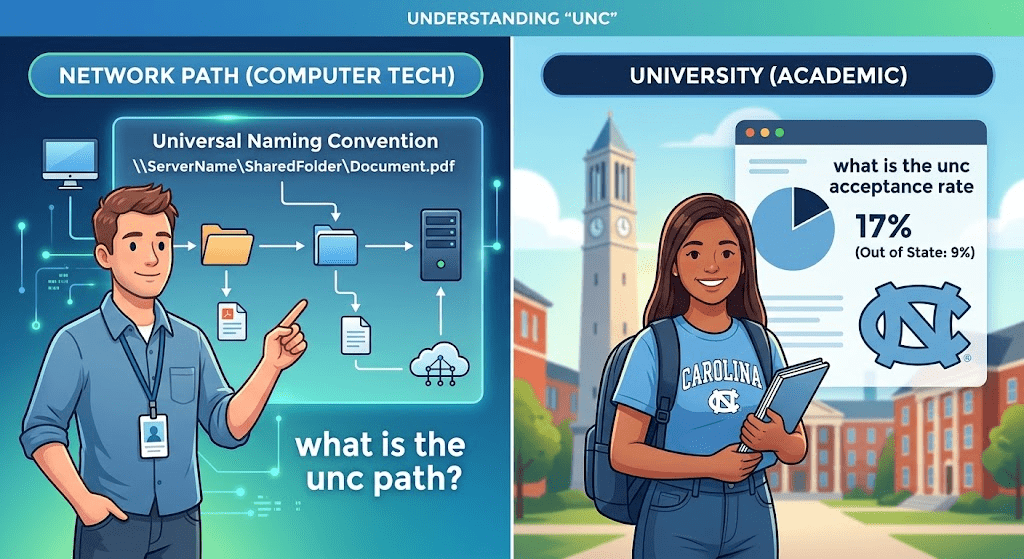
When people search for “what is the unc,” they are usually looking for one of two completely different things. First, in computer tech, it stands for Universal Naming Convention. Second, in higher education, it refers to the famous University of North Carolina. Both topics are important in their own fields. Tech professionals use network paths daily to share files across servers. Meanwhile, thousands of students apply to the university every year, making its admission standards a hot topic.
Understanding both meanings helps clear up common confusion. Whether you are fixing a broken shared folder link or preparing a college application, having clear facts makes your life much easier. This complete guide breaks down both subjects using simple language. We will look at tech standards, admissions trends, and essential facts to give you a complete picture.
Table of Contents
Detailed Overview: Tech vs. University
| Feature / Detail | Universal Naming Convention (Tech) | University of North Carolina (School) |
| Primary Category | Computer Networking & File Systems | Higher Education Institution |
| Core Meaning | Standardized address syntax for network resources | Flagship public research university system |
| Main Usage | Connecting to shared folders, drives, and printers | Earning degrees, academic research, sports |
| Key Metric / Format | \\ServerName\SharedFolder\File | ~15% to 17% Overall Acceptance Rate |
| Target Audience | System admins, IT pros, network users | High school students, scholars, applicants |
What Is The UNC Path in Computer Networking?
A network path helps your computer find files saved on another device. When asking what is the unc path, you are looking at a uniform naming format used by Microsoft Windows. It lets computers connect directly to shared folders and network printers without assigning a traditional local drive letter.
Instead of using standard local paths like C:\Folder, network addresses use double backslashes at the start. This tells your computer to look across your local network rather than on your local hard drive. It keeps network file sharing organized, reliable, and easy for everyone on the team to access.
\\ServerName\SharedFolder\SubFolder\File.txt
How Does a Network Path Work in Windows?
Every shared item on a network needs a clear address so devices can find it quickly. Windows uses special network protocols like Server Message Block (SMB) to send requests across your local area network. When you enter a network folder address, your computer reaches out to the host server directly.
The main advantage is that network addresses stay the same for every user on the system. Mapped drive letters can change from one laptop to another, causing broken shortcuts. A standardized network address ensures that a file link sent to a coworker opens smoothly on their screen every single time.
Syntax and Structure of Network File Addresses
Understanding the structure of a network address is simple once you break down its parts. Every valid network folder link follows a strict, logical pattern from left to right.
- Double Backslash (\\): Signals to the operating system that a network location is being requested.
- Server Name: The unique hostname or IP address of the main network computer hosting the data.
- Share Name: The top-level folder name made public by the system administrator.
- FilePath: Optional internal subfolders and the exact target file name.
For example, \\OfficeServer\Finance\2026_Report.pdf clearly points your system to a specific accounting file.
Network Address Examples for Daily IT Tasks
IT administrators use network addresses every day to manage company systems, run remote backups, and set up shared printers. Here are three practical examples showing how these addresses function in daily business environments:
- Accessing Shared Documents: \\HQ-Data-01\Public\Templates opens the company template library for all employees on the network.
- Connecting Remote Printers: \\PrintServerMain\HR-Color-Printer sends print jobs directly to an office printer.
- Automating File Backups: \\BackupDrive\DailySnapshots\Server1 gives automated software an exact destination for nightly security backups.
Common Mistakes with Network File Paths
It is easy to make simple typing mistakes when entering network file addresses. The most common mistake is using forward slashes (//) instead of backslashes (\\). Web addresses use forward slashes, but Windows network paths strictly require backslashes.
Another frequent issue is leaving out the main share name. Typing only \\ServerName without a target folder often results in an error message or an empty window. Additionally, spaces in folder names should be checked carefully, as missing quotes in command lines can cause scripts to fail instantly.
What Is The UNC Acceptance Rate for College Admissions?
Switching gears to higher education, many prospective students ask what is the unc acceptance rate when researching top universities. This metric refers to the admissions selectivity of the University of North Carolina at Chapel Hill. UNC Chapel Hill is widely recognized as one of the elite public universities in the United States.
The overall acceptance rate typically ranges between 15% and 17%. This means that out of every 100 hopeful applicants, fewer than 17 receive an official acceptance letter. The admissions process is highly competitive, attracting top students from across the world.
In-State vs. Out-of-State Acceptance Rates
The overall admission rate does not tell the full story for prospective students. Because UNC Chapel Hill is a state-funded institution, state guidelines mandate that roughly 82% of the undergraduate student body must come from North Carolina.
- In-State Applicants: North Carolina residents enjoy a significantly higher acceptance rate, often ranging between 37% and 43%.
- Out-of-State Applicants: Non-resident competition is fierce, with the acceptance rate dropping sharply to 7% to 9%.
Out-of-state applicants face selectivity levels similar to Ivy League schools.
What Do You Need to Get Accepted into UNC?
Gaining admission requires far more than just average high school grades. Successful applicants consistently demonstrate high academic achievement, leadership, and personal character throughout high school.
The vast majority of admitted students rank in the top 10% of their graduating high school class. Most accepted applicants present weighted GPAs well above 4.0, taking rigorous Advanced Placement (AP) or International Baccalaureate (IB) courses. Admissions officers also evaluate personal essays, letters of recommendation, and community involvement to build a well-rounded class.
How to Build a Strong College Application
To stand out in a competitive applicant pool, focus on quality over quantity. Admissions teams want to see real commitment, self-motivation, and unique personal interests.
- Maintain Academic Rigor: Take advanced courses offered by your high school to show academic readiness.
- Write Authentic Essays: Craft personal stories that highlight your genuine personality, growth, and voice.
- Show Deep Engagement: Focus deeply on two or three meaningful extracurricular activities rather than joining dozens of clubs.
- Apply Early: Submitting your application during the Early Action deadline shows clear enthusiasm and interest.
Comparing Network Tech Terms with Academic Terms
Because the acronym is so popular across different fields, context is everything. In technical IT documents, “UNC” always points to system architecture, network protocols, and shared storage paths. In academic counseling, the same letters refer to campus culture, college majors, and admissions stats. Recognizing which meaning applies ensures clear communication whether you are writing code or filling out college forms.
Frequently Asked Questions
What is the full form of UNC in computer networking?
In computer networking, it stands for Universal Naming Convention (or Uniform Naming Convention). It is used to specify the exact location of shared network resources on Windows operating systems.
How do I find a UNC path for a mapped drive in Windows?
Open Command Prompt and type net use, then press Enter. Windows will display a complete list showing local drive letters alongside their original network addresses.
Is UNC pathing supported on Mac and Linux systems?
Windows relies on backslashes for network paths, while Linux and macOS use forward slashes (such as smb://server/share). However, modern operating systems can easily connect to shared Windows folders.
Why is the UNC out-of-state acceptance rate so low?
North Carolina state guidelines require that about 82% of enrolled undergraduates be state residents. Because non-residents compete for a limited number of remaining seats, out-of-state acceptance rates are very selective.
Does UNC Chapel Hill require SAT or ACT scores?
Standardized testing policies can change annually, but competitive applicants who submit scores typically fall within high percentile ranges (e.g., SAT 1390-1530, ACT 29-34). Always check official admissions guidelines for current policy updates.
Can I convert a mapped drive letter into a UNC path?
Yes, you can right-click a mapped drive shortcut, check its properties, or run the net use command in your terminal to see the original network folder address.
Conclusion
Understanding what is the unc depends entirely on whether you are working with network folders or researching higher education. Knowing how to use what is the unc path allows IT workers to share files seamlessly across complex local networks. On the academic side, knowing what is the unc acceptance rate gives aspiring college students realistic expectations for their application strategy.
Which topic brought you here today? Leave a comment below or share this helpful guide with friends, classmates, or IT teammates!
